
Application maintenance services are the ongoing engineering work required to keep software working correctly after launch. In practice that means four distinct types of work: corrective maintenance, which fixes defects; adaptive maintenance, which keeps the application compatible with new operating systems, browsers, devices and third-party APIs; perfective maintenance, which improves performance and usability; and preventive maintenance, which reduces future failure through refactoring, dependency updates and security hardening.
This page is written for three situations. The first is an application built by an agency whose contract has ended, leaving nobody accountable when something breaks. The second is an internal team that has lost the engineers who built the system and can no longer safely change it. The third is a growing product where the development team is being pulled off roadmap work to firefight production issues, and the roadmap is slipping as a result.
If any of those describes your position, the requirement is not another build project. It is a maintenance partner with defined response times and a documented handover.
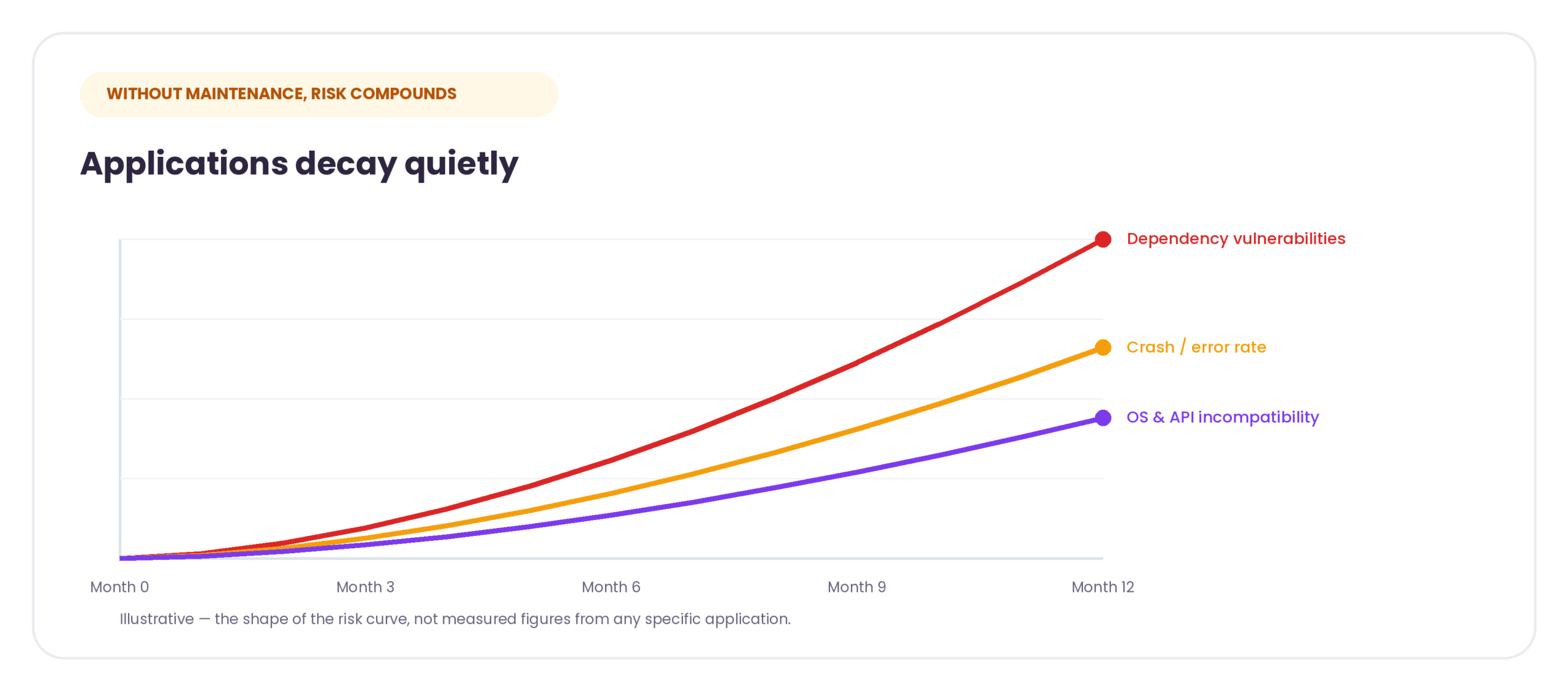
A live application does not stay still even when nobody changes it. Apple and Google ship operating system releases on a fixed annual cadence and periodically deprecate APIs. Browsers change rendering behaviour. Payment providers, mapping services, authentication providers and analytics vendors all version their APIs and eventually retire the old ones. Frameworks and libraries publish security advisories continuously. An application that is untouched for twelve months is not stable; it is accumulating risk.
The commercial consequences arrive in a predictable order. Crash rates creep upward and store ratings fall. Load times drift and conversion follows. A dependency reaches end of life and a security scan flags it during a client due-diligence process. Then a store submission is rejected for an SDK requirement nobody was tracking, and a straightforward compliance update becomes an emergency.
The underlying issue is ownership. Most applications in this state have no named engineer, no monitoring, no defined severity levels and no agreed response time. Work happens when someone complains loudly enough. Maintenance done that way costs more than maintenance done on a schedule, and it costs it at the worst possible moment.
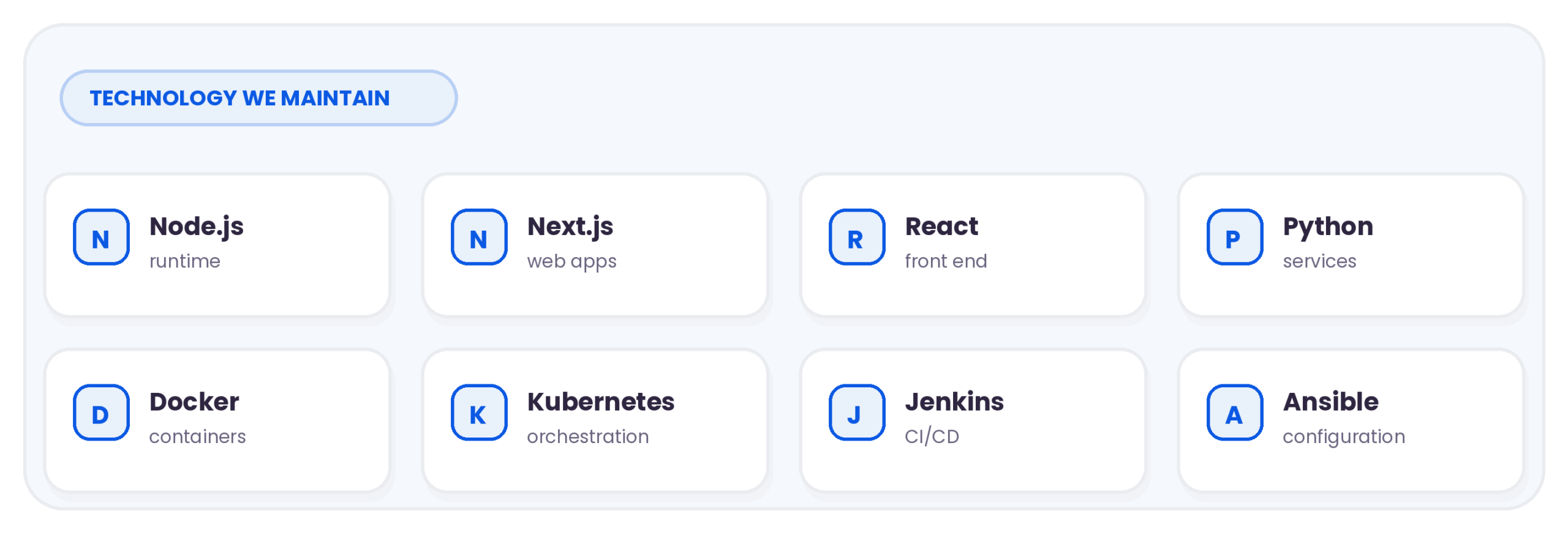
Autviz maintains applications across the stack our teams build in: JavaScript and TypeScript, Node.js, Next.js and React on the web; Python for services, data and machine-learning workloads; Streamlit for internal tooling; and native and cross-platform mobile applications. Deployment and operations work runs on Docker, Kubernetes, Jenkins, Ansible and Heroku, across the major cloud platforms. Where an application includes machine-learning components, we maintain models and pipelines built with PyTorch, TensorFlow, scikit-learn, Azure ML or AWS SageMaker. Automation and integration layers built on n8n, Make.com, LangChain or CrewAI are maintained by the same team that builds them.
Two commercial models are available. A fixed monthly retainer covers an agreed scope, severity model and enhancement allowance, and suits applications with steady, predictable support needs. A dedicated development team engagement provides named engineers working to your backlog, and suits organisations that need continuous roadmap delivery alongside maintenance. Where an application is being modernised rather than simply kept alive, maintenance runs in parallel with a digital transformation workstream.
Prefer to write first? Email Sales@autviz.in or call +91 9876341464.
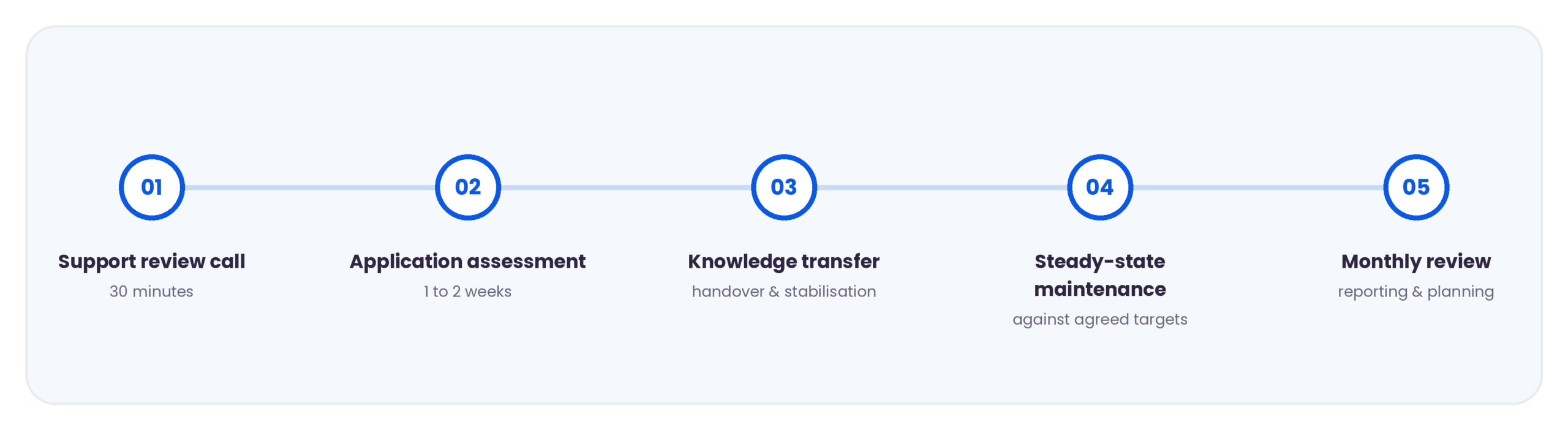
Tell us what the application is, what stack it runs on and what has been breaking. In 30 minutes we will give you a clear read on the immediate risks, what a sensible support scope looks like, and how a handover would work if your current team is stepping away.
Application maintenance services include monitoring and alerting, defect resolution, security patching and dependency updates, operating system and third-party API compatibility work, performance optimisation, database maintenance and a defined allowance for minor enhancements. Most providers, including Autviz, structure this across four maintenance types: corrective, adaptive, perfective and preventive. The exact scope, severity levels and response times are agreed in writing before the retainer begins.
Published industry guidance commonly puts annual maintenance at roughly 15 to 20 per cent of the original development cost, with reported ranges from a few thousand dollars a year for simple applications to six figures for complex enterprise systems. The real drivers are the number of integrations, the state of the codebase and the response times you require. Autviz quotes after the application assessment, not before.
Yes. Taking over applications from a previous agency or a departed internal team is a routine engagement for us. We begin with a code and infrastructure assessment, take handover where the outgoing team is available, and reconstruct the missing documentation where they are not. You receive architecture documentation, a deployment runbook and a prioritised risk register as part of the transition.
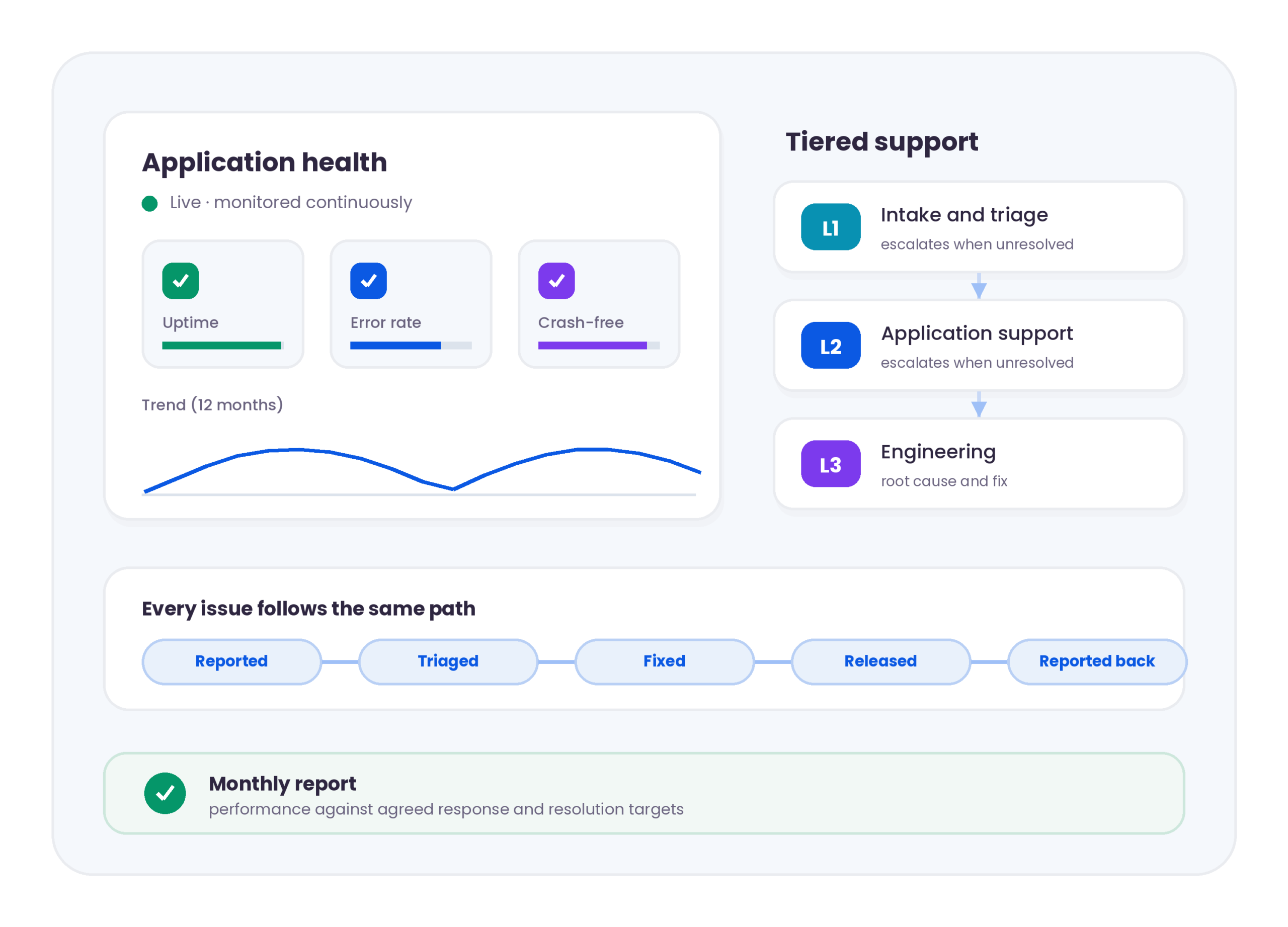
Support is reactive and user-facing: receiving issues, triaging them and restoring service. Maintenance is the engineering work behind it, including defect fixes, security patching, compatibility updates and performance improvements. In practice they are delivered together, which is why the structure is tiered. L1 and L2 handle support; L3 performs the maintenance engineering.
A live mobile application needs attention continuously, with two fixed annual peaks around the major iOS and Android releases. Between those, expect monthly dependency and security review, ongoing crash monitoring, and reactive work when a third-party SDK or store policy changes. Mobile app maintenance services are scoped to that external cadence because the release schedule is not yours to control.
Yes, within the technology families our engineers work in. Legacy application maintenance typically starts with stabilisation rather than change: establishing monitoring, documenting how the system actually works, and reducing security exposure. Only once the application is stable do we advise on whether incremental modernisation or replacement is the better commercial decision. We will tell you plainly if a system is beyond safe maintenance.
Response and resolution targets are agreed per severity level before the retainer starts, alongside your required support-hours coverage. Critical production incidents carry the shortest targets; minor cosmetic issues are scheduled into the normal release cycle. Performance against those targets is reported monthly. We set targets we can meet with the agreed team size rather than quoting figures that look good in a proposal.
Connect with us today to kickstart your digital transformation journey
It was very easy communicating with Gautam. He quickly understood our design needs and implemented them. He also came up with some good suggestions on his own, and the end-product looked great.
Enjoyed working with Gautam, knowledgeable and really picked up an existing codebase..
Was not afraid to recognize the mistakes and always tried to improve this. Will work again with Reena in the future.
Working with Autviz Solution was excellent. They deliver quality work promptly and are highly responsive. I'd work with them again. Thank you!"
Autviz (Reena) is a highly intelligent and hardworking freelancer. She is great about confirming how long projects would take and has a great work ethic.
In Just 10 min You Will Get A Response



.webp)