
Autviz Solutions designs and builds RPA development services for organisations that want repetitive back-office work handled reliably, without a licensed bot platform sitting between them and their own systems. We automate at the API and AI-agent layer, so the automation survives a screen redesign.
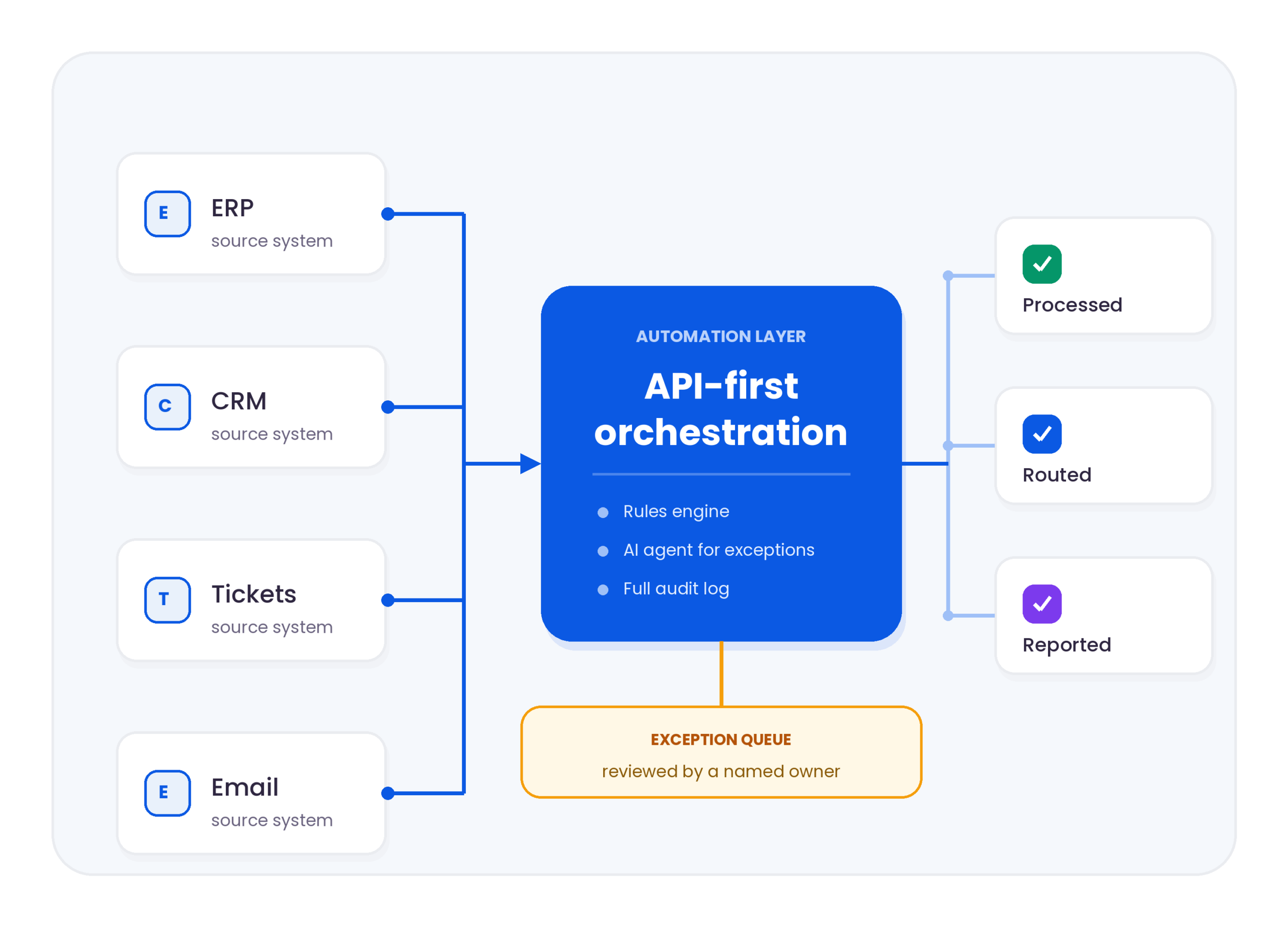
Robotic process automation is the practice of handing a defined, repeatable business process to software so that people stop doing it manually. In its original form, that meant a bot recording keystrokes and mouse clicks against a user interface. The definition has moved on. Modern RPA development services cover process discovery, automation design, build, integration, testing, deployment and ongoing supervision of the automation once it is live.
This page is written for organisations with a specific shape of problem. You have a team spending a meaningful share of every week moving data between systems that do not talk to each other. You have processes documented in someone’s head rather than in a runbook. You have already tried to fix it with spreadsheets and rules in your ERP, and it did not hold. Finance operations, order management, HR administration, claims handling, procurement and customer support back-office teams are where this work usually sits.
If you are automating fewer than three processes, you probably do not need a platform licence. You need a partner who will map the work properly and build something that runs.
Repetitive process work rarely appears as a line item on a budget. It hides inside headcount. A finance clerk spends two hours a day rekeying supplier invoices; a support agent copies ticket data into a billing system; an HR coordinator chases the same six approvals every onboarding. None of it is visible enough to justify a project, and all of it compounds.
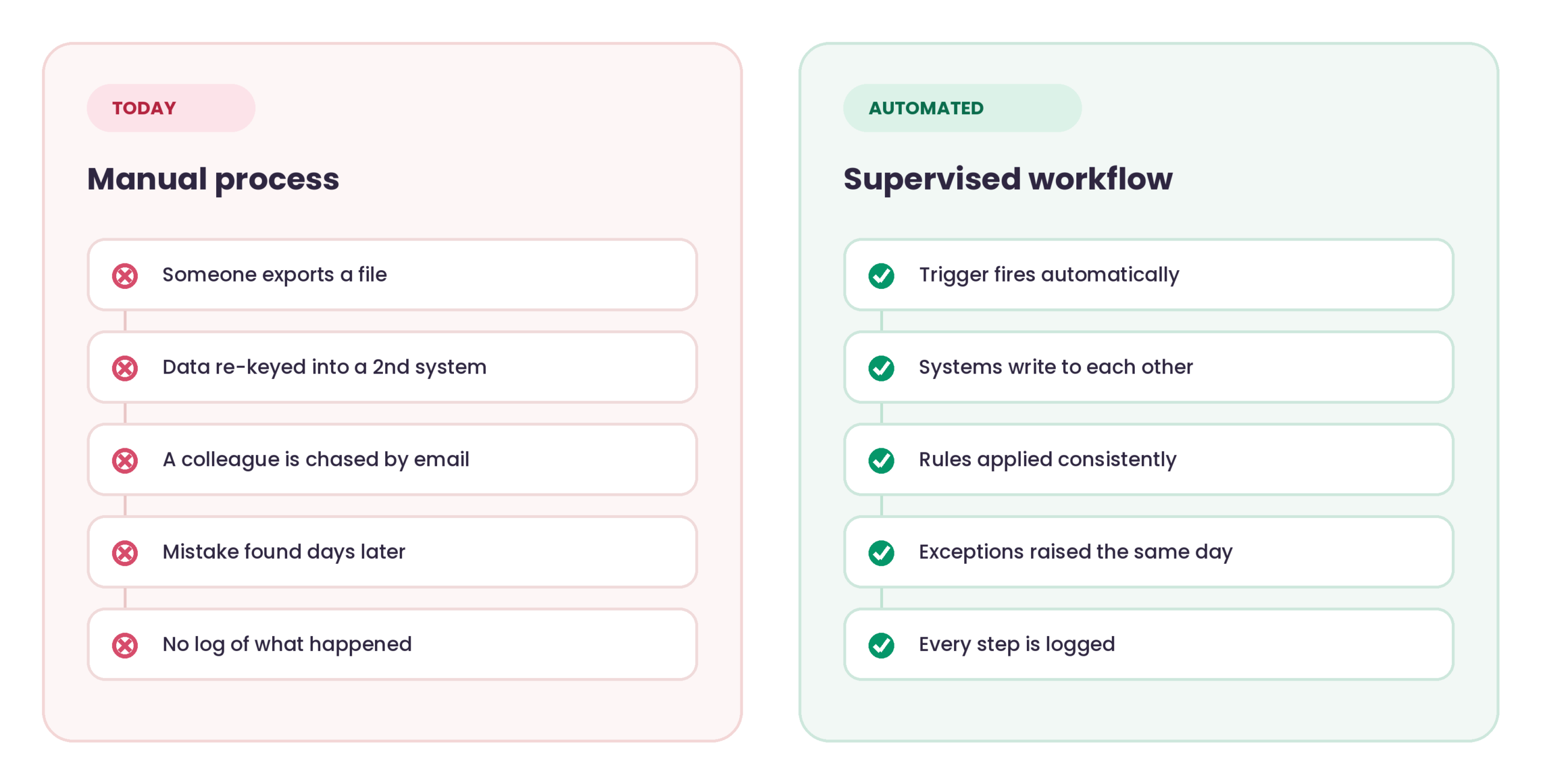
The second problem is fragility. Where automation does exist, it is often a recorded UI script or a personal macro built by someone who has since left. It breaks when a vendor ships a new release, and nobody notices for a fortnight. The organisation then concludes that automation does not work, when what actually failed was the method.
The third problem is exception handling. Rules-based automation handles the clean 70 per cent of cases and dumps the remaining 30 per cent back on the team, often with less context than they had before. That is where most automation programmes stall, and it is the specific gap that AI-led automation was built to close.
We should be direct about our method, because it differs from vendors who resell platform licences.
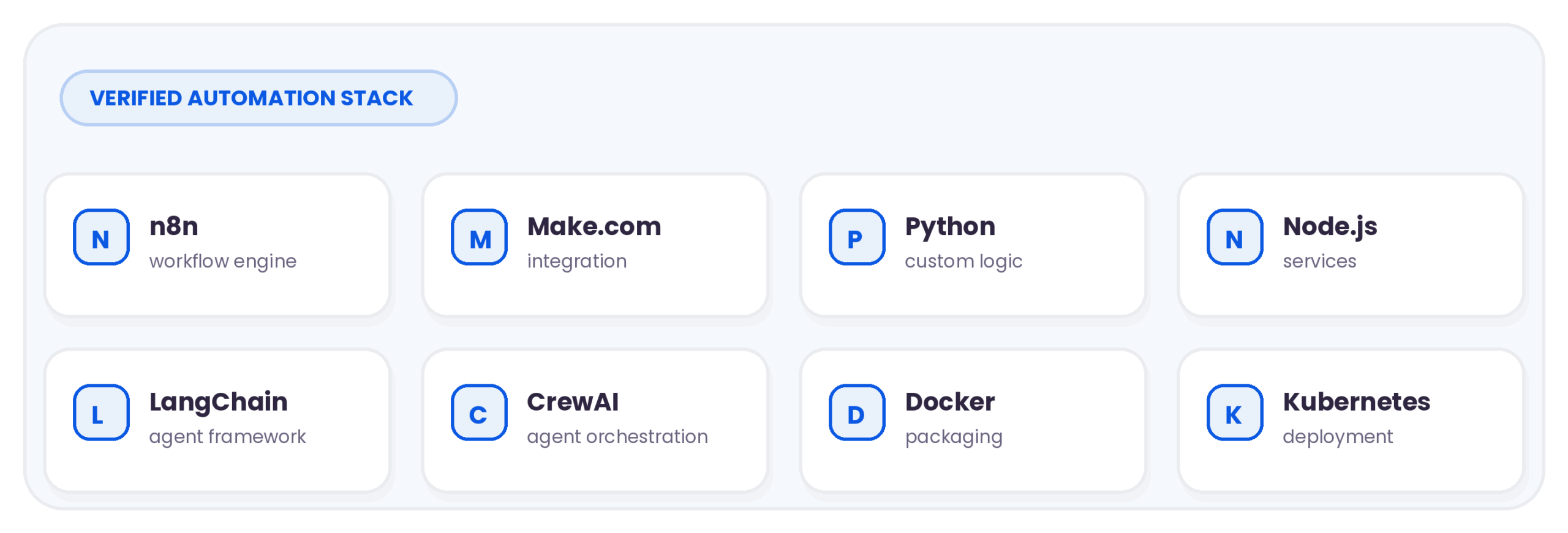
Autviz does not implement UiPath, Blue Prism or Automation Anywhere. We build process automation on an open, API-first stack: n8n and Make.com for orchestration, Python, JavaScript and TypeScript for custom logic, Node.js and Next.js for services and interfaces, LangChain and CrewAI for agent behaviour, and vector databases including Pinecone, Qdrant, Weaviate and Chroma for retrieval. Where a process needs a trained model rather than a prompted one, we use PyTorch, TensorFlow or scikit-learn, deployed through Azure ML or AWS SageMaker. Deployment runs on Docker and Kubernetes with Jenkins and Ansible.
Three consequences follow, and they are the reason we work this way. First, there is no per-bot licence fee attached to the automation, so the economics do not degrade as you scale. Second, integrating at the API layer removes the single largest cause of automation failure, which is a user interface changing underneath a screen-scraping script. Third, an agent-led design handles the exceptions that rules-based bots hand back to your team.
The trade-off is real and worth stating. If your requirement is specifically a licensed enterprise RPA platform with a vendor-certified control room, we are not the right partner and we will tell you at the discovery call. If your requirement is for the process to run reliably at a sensible cost, this approach is stronger. Our broader AI automation services practice and our AI agent development team share the same delivery stack, so an automation can grow into a full agent without being rebuilt.
Prefer to write first? Email Sales@autviz.in or call +91 9876341464.
RPA development services are end-to-end services for automating repetitive, rule-based business processes, covering process discovery, automation design, build, system integration, testing, deployment and ongoing supervision. Traditional RPA automates through the user interface. Autviz delivers the same outcomes through APIs, custom code and AI agents, which removes licence costs and makes the automation far less likely to break when a system is updated.
Cost depends on process complexity, the number of systems involved and how clean the underlying data is. Published industry ranges span a few thousand dollars for a single simple automation to six figures for multi-system enterprise workflows. Autviz quotes per process after the assessment stage, not before, because an accurate figure requires knowing the exception rate. The assessment itself gives you a costed backlog you can budget against.
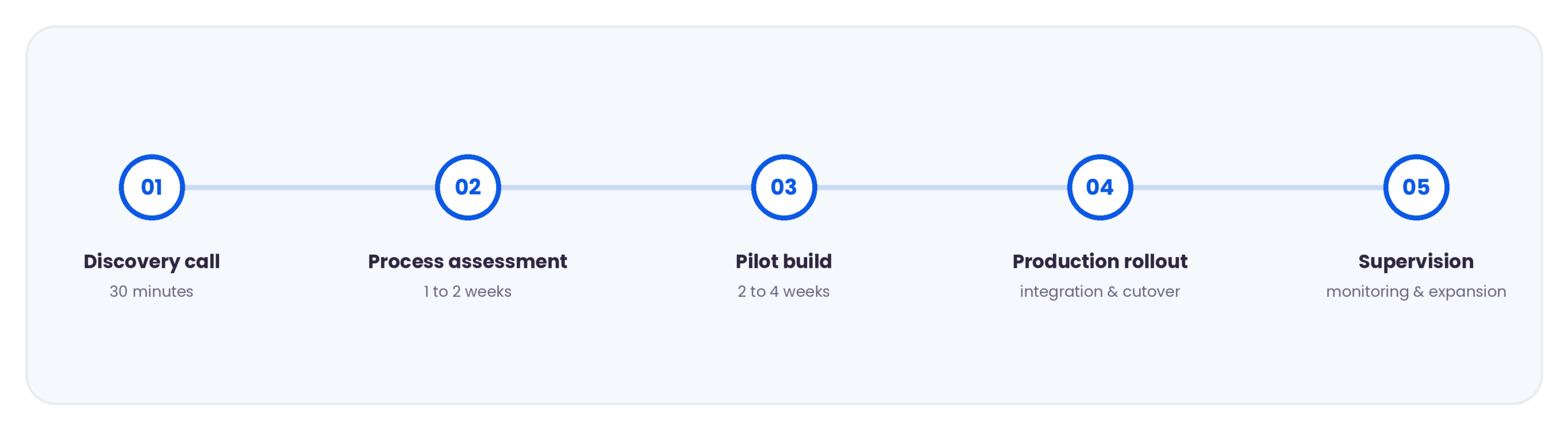
A single well-scoped process typically moves from assessment to production in four to eight weeks: one to two weeks of process assessment, two to four weeks of pilot build, then integration testing and cutover. Processes with unclear rules, poor data quality or systems without APIs take longer. We give you a timeline at the end of the assessment, not at the sales stage.
RPA follows fixed rules; AI agents interpret and decide. RPA is well suited to high-volume, predictable tasks with stable rules. AI agents handle the steps requiring judgement, such as reading an unstructured document or deciding how to route an unusual case. Most real processes need both. Autviz builds them together rather than treating them as competing technologies.
No. Autviz does not implement licensed RPA platforms and holds no partnership or certification with those vendors. We build process automation on an open stack: n8n, Make.com, Python, Node.js, LangChain and CrewAI, deployed with Docker and Kubernetes. If your organisation has mandated a specific licensed platform, we will say at the first call that we are not the right fit.
The best candidates are high-volume, rule-based, digitally triggered and stable. Invoice processing, order entry, employee onboarding, ticket triage, recurring reporting and CRM data hygiene are consistently strong. Poor candidates are processes that change monthly, depend heavily on undocumented judgement, or run fewer than a handful of times a week. The assessment stage scores each candidate before anything is built.
Every automation ships with logging, failure alerting and an exception queue reviewed by a named owner. Autviz provides monitoring, monthly performance reporting and change support as systems and rules evolve. We also transfer ownership properly, with a runbook and training for your team, so the automation is maintainable whether or not we remain engaged.
Connect with us today to kickstart your digital transformation journey
It was very easy communicating with Gautam. He quickly understood our design needs and implemented them. He also came up with some good suggestions on his own, and the end-product looked great.
Enjoyed working with Gautam, knowledgeable and really picked up an existing codebase..
Was not afraid to recognize the mistakes and always tried to improve this. Will work again with Reena in the future.
Working with Autviz Solution was excellent. They deliver quality work promptly and are highly responsive. I'd work with them again. Thank you!"
Autviz (Reena) is a highly intelligent and hardworking freelancer. She is great about confirming how long projects would take and has a great work ethic.
In Just 10 min You Will Get A Response



.webp)