
September 2, 2026
Category: AI
UGC-style ads still convert better than polished brand videos for one simple reason: they look like a real person talking to a real person, not a company selling a product. The problem has always been speed — filming, editing, and licensing real creator content is slow and expensive to test at scale. That’s exactly the gap AI UGC ads for ecommerce close. With AI Creative Studio, brands can generate dozens of on-brand, testable UGC-style variations in the time it used to take to shoot one.
This guide walks through how AI-generated UGC ad creative is actually planned, produced, and tested — from hook selection to brand safety to measuring what’s working — so you can build a repeatable creative testing engine instead of a one-off video.
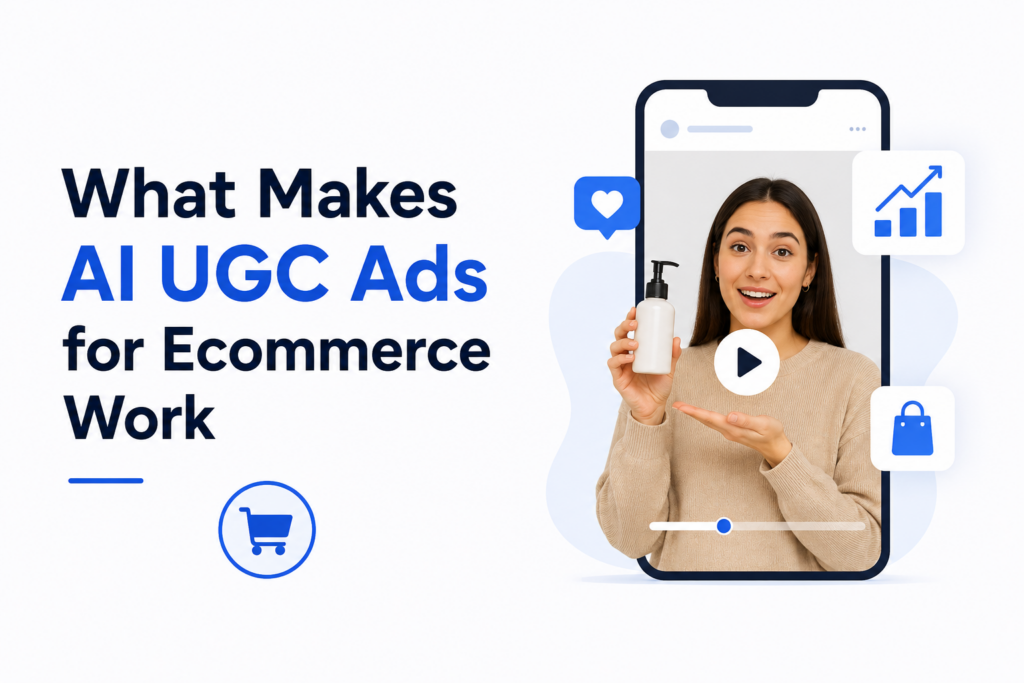
1. What Makes AI UGC Ads for Ecommerce Work
Before generating anything, it helps to know what separates a UGC-style ad that performs from one that just looks like UGC. The format works because it borrows trust signals from organic content. Imperfect framing, casual delivery, and real reactions make the ad feel more authentic while keeping the commercial message clear. A good UGC-style ad usually has:
- 1. A hook in the first 1-2 seconds that stops the scroll, not a slow brand intro
- 2. A relatable presenter or voice, not a polished spokesperson tone
- 3. Visible product proof — the item being used, unboxed, or shown solving a problem
- 4. A natural-sounding call to action, not a hard sales pitch
With AI generated UGC videos, teams can build and recombine all four elements systematically, making it easier to test different creative variations., which is the real advantage over traditional creator briefs — you’re not waiting on one creator’s single take, you’re testing structured variations of the same winning formula.
2. Choose the Hook, Audience and Product Proof
Every strong ecommerce UGC ad creative starts before a single frame is generated — with a clear hypothesis about who you’re talking to and what will make them stop scrolling. This planning stage typically covers three decisions:
- The hook angle: a problem statement, a bold claim, a before/after moment, or a relatable complaint your audience already has
- The audience segment: the specific persona this variation speaks to — tone and language shift depending on whether you’re targeting a first-time buyer or a repeat customer
- The product proof: what visual evidence backs up the claim — a demo, a close-up of a result, a comparison, or a genuine-looking reaction
Weak hooks produce weak ads, no matter how good the AI product ads engine is. AI-driven planning tools can also help sharpen the brief before production starts., like those covered in our AI automation for ecommerce guide, can help pull signal from past-performing creative and customer language to sharpen the brief before production starts.
3. How to Create AI UGC Ads for Ecommerce: Script, Generate, Edit and Localize
Once the brief is set, production moves fast. A typical workflow looks like:
- Script the variation — a short, conversational script built around the chosen hook, kept under 15-20 seconds for most placements
- Generate the AI UGC video — using a consistent presenter style or a rotating set of AI presenters to avoid ad fatigue across variations
- Edit for pacing and captions — trimming dead air, adding burned-in captions (most viewers watch muted), and syncing product cutaways to the script
- Localize where needed — swapping language, currency, and cultural references for different markets without re-shooting anything
This is where AI UGC ad production outpaces traditional creator content. You can regenerate the same script across five hooks, three presenter styles, and two languages in one sprint. That gives you a real testing matrix instead of one asset and a guess.
4. Brand Safety, Claims and Usage Rights
Speed only helps if what you’re publishing is compliant and defensible. Before publishing any AI UGC ad, teams should run it through a brand safety checklist:
- Claims review: product Every product claim in the script should match verified and substantiated information — AI-generated confidence in delivery doesn’t excuse an unsupported claim
- Disclosure compliance: ads that look like organic UGC still need to meet platform and regional disclosure requirements for paid or sponsored content
- Usage rights: confirm the AI presenter, voice, and any generated likeness are licensed for commercial ad use, not just internal testing
- Brand tone guardrails: even fast-generated variations should stay inside pre-approved language, so nothing off-brand slips into a live campaign
This is typically where a creative studio partner earns its value — setting up the guardrails once so every future batch of AI-generated ads is compliant by default, rather than reviewing each asset manually.
5. How to Test AI UGC Ads for Ecommerce: Hooks, Formats and CTAs
The whole point of building AI UGC ads at speed is to test more, not just publish faster. A structured testing approach usually isolates one variable at a time:
- Hook testing: run 3-5 different opening lines against the same script and product proof to find which angle earns the most watch-through
- Format testing: compare vertical short-form, square feed placements, and longer-form explainer cuts of the same core creative
- CTA testing: vary the closing line and on-screen action — “shop now,” a limited-time framing, or a softer “see for yourself” — to see what actually drives clicks for your audience
AI UGC ad creative can be regenerated quickly. This allows teams to run testing cycles weekly instead of quarterly. Ecommerce teams can move from a few “hero” videos to a constant creative testing pipeline.
6. Measure Creative Performance and Iterate
Once variations are live, the metrics that matter most for UGC-style ads are usually earlier in the funnel than final conversion:
- Hook rate — the percentage of viewers who watch past the first 2-3 seconds, which tells you if the opening actually works
- Hold rate / watch-through — how much of the ad people actually watch, a strong signal of whether the product proof is landing
- Click-through rate — whether the CTA and offer are compelling enough to act on
- Cost per acquisition — the ultimate business metric, but one that should be read alongside the earlier signals, not instead of them
Feed winning hooks and formats into the next batch of AI UGC ads, and retire underperforming angles.of AI UGC ad generation, and underperforming angles retired — turning creative production into a continuous loop rather than a one-time campaign. For ecommerce brands running this alongside conversational selling, pairing tested UGC ad creative with a system like AI Sales Agent can help carry that same tested messaging from the ad into the on-site or chat conversation.
Turning This Into a Repeatable Creative Engine
AI UGC ads for ecommerce aren’t a one-time creative project — they work best as an ongoing testing system: brief, generate, review for brand safety, test, measure, and feed learnings back into the next batch. That loop is what actually compounds performance over time, far more than any single “viral” ad.
If you want to see finished examples of AI-generated UGC-style ad creative before committing to a workflow, browse our creative portfolio — or if you have a specific product and audience in mind, request a concept and we’ll show you what a tested batch could look like for your brand.


.webp)