
August 24, 2026
Category: AI
Every vendor conversation about automating support, sales, or operations eventually lands on the same question: do you need a chatbot, or do you need an AI agent? Sales teams often use the two terms interchangeably, but they solve different problems, cost differently, and take different amounts of time to launch. If you’re considering an ai chatbot development service, it’s important to understand when a chatbot is enough and when an AI agent makes more sense. Businesses that need a tailored conversational solution can explore custom chatbot solutions designed for their specific workflows.
This guide breaks down the real difference in plain English, what a chatbot simply can’t do, how cost and timelines compare, and a practical framework for deciding which one fits your business today. For a deeper technical breakdown, our dedicated AI agent vs chatbot comparison covers the architecture side in more detail.
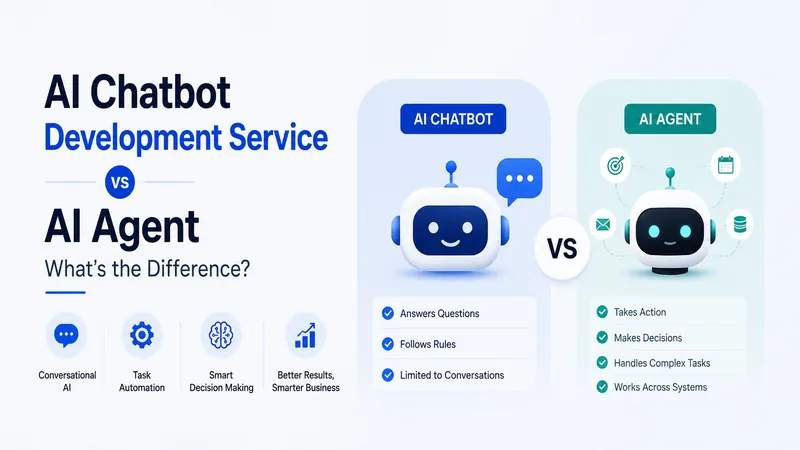
AI Chatbot Development Service vs AI Agent — What’s the Difference?
The simplest way to think about it: a chatbot answers, an agent acts.
| Trait | Chatbot | AI Agent |
|---|---|---|
| How it works | Follows scripted flows or a decision tree, sometimes with an LLM layered on top for phrasing | Reasons through a goal, decides which tools to use, and adapts the plan as it goes |
| Can take actions? | Usually no — it answers or routes to a human | Yes — updates a CRM, issues a refund, schedules a task, calls an API |
| Handles multi-step work? | No — one question, one answer | Yes — chains steps together toward an outcome |
| Memory across sessions? | Rarely | Often — retains context relevant to an ongoing task or customer |
| Best fit | FAQ deflection, simple lead capture, basic triage | End-to-end workflows: support resolution, order processing, internal operations |
What an AI Chatbot Development Service Can’t Do That an AI Agent Can
Chatbots hit a ceiling fast, and it’s usually the same ceiling regardless of vendor:
-
- No real action-taking. A chatbot can tell a customer their order is delayed; it generally can’t reissue a shipment, apply a credit, or update the order status itself.
-
- No multi-step reasoning. If solving a customer’s problem requires checking three systems and making a judgment call, a scripted flow breaks down after step one.
-
- No adaptation mid-conversation. When the conversation moves outside the pre-built flow, most chatbots fall back to “let me connect you with a human” rather than reasoning through the new situation.
-
- No persistent context. Each new session often starts from zero, so returning customers must repeat information that a human colleague — or an agent — could already remember.
-
- No tool use. Chatbots are built to talk. Agents are built to talk and do, calling APIs and internal tools as part of completing the task.
None of this makes chatbots useless — it just means they’re the right tool for a narrower slice of the problem than most businesses initially assume.
AI Chatbot Development Service: Cost and Timeline
The cost of an ai chatbot development service depends on factors such as chatbot complexity, integrations, conversation design, AI model usage, and ongoing maintenance.
| Chatbot | AI Agent | |
|---|---|---|
| Typical build time | Days to a few weeks | Several weeks to a few months, depending on integrations |
| Main cost driver | Conversation design and content | System integrations, tool access, testing, and guardrails |
| Ongoing cost | Low — mostly hosting and content updates | Higher — model usage scales with actions taken, plus monitoring |
| Maintenance | Update scripts as FAQs change | Ongoing evaluation as workflows, tools, or policies change |
The gap in upfront cost is real, but so is the gap in what you get back. A chatbot that deflects FAQs saves support time; an agent that actually resolves tickets end-to-end removes headcount pressure. The right comparison isn’t cost alone — it’s cost against the volume and complexity of the work being automated.
Choosing an AI Chatbot Development Service for Your Business
For businesses focused on customer support, lead qualification, or FAQ automation, an ai chatbot development service can be a practical starting point before investing in a more complex AI agent
A few honest questions cut through most of the confusion:
-
- Does resolving the request require touching more than one system? If yes, a chatbot will bottleneck at handoff — you need an agent.
-
- Is the volume high enough to justify integration work? Low-volume, simple questions rarely justify agent-level investment. Start with a chatbot.
-
- Does the task need a judgment call, not just an answer? Refund approvals, escalation decisions, and prioritization calls need agent-level reasoning.
-
- Do you already have a chatbot that’s plateaued? If it’s deflecting the easy 60% but stalling on the rest, that’s usually the exact signal to move to an agent for the harder cases.
-
- What’s your risk tolerance for autonomous action? If your team needs to approve every action, a chatbot plus a human-in-the-loop process may work better for now.
Many businesses land on both: a chatbot for simple, high-volume front-line questions, and an agent for the workflows underneath that actually need to get done.
AI Chatbot Development Service vs AI Employees: What’s the Difference?
This is the exact gap Autviz’s AI Employees are built to close. Rather than bolting a scripted flow onto a website, an AI Employee reasons through a task, pulls from your actual business systems, and takes the next action — updating a record, drafting a response, escalating when something falls outside its scope — instead of stopping at “here’s an answer” and handing the rest back to a person.
That’s the practical difference between a chatbot and an agent playing out in a real deployment: the chatbot tells a customer their invoice is overdue, while an AI Employee can check the account, apply the right policy, and resolve it. If you’re scoping a build rather than a packaged AI Employee, our services page covers how a custom project comes together, and our breakdown of AI development services walks through the process, timeline, and team structure in more depth.


.webp)