
August 31, 2026
Category: AI Development
AI mobile app development companies are helping businesses build smarter, faster, and more personalized mobile applications in 2026. AI is no longer just a bolt-on feature for mobile apps—it is becoming a core part of app development, from intelligent automation and personalization to predictive analytics and AI-powered user experiences. In this guide, we compare the top 10 AI mobile app development companies in 2026 to help you find the right development partner.
How This List Was Put Together
To create this list, these companies were selected based on publicly visible specialization in AI-driven mobile development, the range of industries they serve, and how clearly they differentiate AI feature work (like on-device ML or generative AI integration) from general app development. Pricing, team size, and specific ratings shift often, so treat the figures below as directional starting points for conversations, not fixed quotes.
Top 10 AI Mobile App Development Companies in 2026
1. Autviz
For example, Autviz builds AI-powered mobile and web applications across healthcare, e-commerce, and operations-heavy industries, with a focus on embedding AI directly into product workflows rather than treating it as an add-on. Their work spans AI-driven automation tools, custom integrations, and mobile apps built for regulated and high-compliance environments. Businesses looking for an AI Mobile App Development Services partner that pairs AI capability with practical delivery timelines are a strong fit here.
2. Appinventiv
A large, globally operating firm with a long track record in enterprise mobile app delivery. Appinventiv covers chatbot and conversational AI development, AI-enabled mobile apps, and compliance-aware builds (HIPAA, GDPR) across healthcare, fintech, e-commerce, and travel.
3. Intellectsoft
Known for scalable, cross-platform mobile solutions in high-growth sectors like mobile banking and telemedicine, Intellectsoft blends traditional mobile engineering with AI feature integration for enterprise clients.
4. Simform
Simform is a full-service development shop that pairs mobile app engineering with AI and cloud infrastructure work, often chosen by businesses that need AI features working alongside broader product infrastructure rather than as a standalone feature.
5. LeewayHertz
LeewayHertz focuses heavily on AI and generative AI development, including custom model integration, making it a common pick for companies that need deep AI engineering as the primary scope of the project, with mobile as one delivery surface.
6. Intuz
Intuz specializes in AI-enabled mobile app development with attention to enterprise delivery and industry specialization, often evaluated alongside larger firms for mid-to-large scale AI mobile projects.
7. Cleveroad
A well-established name in native Android, native iOS, and cross-platform development, Cleveroad serves healthcare, finance, and media clients with mobile apps that increasingly include AI-driven personalization and automation features.
8. Konstant Infosolutions
Konstant works with both startups and larger enterprises on AI-driven mobile and web app development, with a broad portfolio spanning multiple industries and app categories.
9. CMARIX
An agile software development company with over a decade of delivery experience, CMARIX has built out AI integration capability alongside native and cross-platform mobile development for clients across multiple countries.
10. Softaims
Softaims positions itself around full-stack AI mobile development — building both the app and the underlying AI model — with an emphasis on handing clients full ownership of the model, data, and code after delivery.
Comparison at a Glance
| Company | Core Strength | Best Suited For | Industries Served |
|---|---|---|---|
| Autviz | AI embedded into product workflows | Startups & mid-size businesses needing AI + compliance | Healthcare, e-commerce, operations |
| Appinventiv | Enterprise-scale delivery | Large enterprise AI mobile projects | Healthcare, fintech, e-commerce, travel |
| Intellectsoft | Scalable cross-platform builds | Regulated, high-growth sectors | Banking, telemedicine |
| Simform | AI + cloud infrastructure pairing | Products needing AI plus infra work | Cross-industry |
| LeewayHertz | Deep generative AI engineering | AI-first projects, mobile secondary | Cross-industry |
| Intuz | Enterprise AI mobile delivery | Mid-to-large scale AI mobile apps | Cross-industry |
| Cleveroad | Native + cross-platform expertise | Traditional mobile with AI add-ons | Healthcare, finance, media |
| Konstant Infosolutions | Broad portfolio, startup-friendly | Startups to enterprise | Cross-industry |
| CMARIX | Agile delivery, global reach | Multi-country distributed teams | Cross-industry |
| Softaims | Full-stack model + app ownership | Teams wanting full IP ownership | Cross-industry |
How to Choose the Right AI Mobile App Development Companies
- First, look for actual data scientists and ML engineers, not just app developers using prompt-based tools., not just app developers using prompt-based tools.
- Next, ask for live examples of AI features in production, not just demos or proofs of concept. of AI features in production, not just demos or proofs of concept.
- In addition, strong AI knowledge means little without solid native or cross-platform mobile engineering without solid native (Swift, Kotlin) or cross-platform (Flutter, React Native) mobile engineering.
- Moreover, a serious partner addresses data privacy, model costs, and compliance requirements early in scoping. data privacy, model costs, and compliance requirements early in scoping, not after launch.
- Similarly, a company with proven work in your exact industry can reduce project risk
- IP and ownership terms — clarify upfront whether you own the trained model, the underlying data, and the full codebase after delivery.
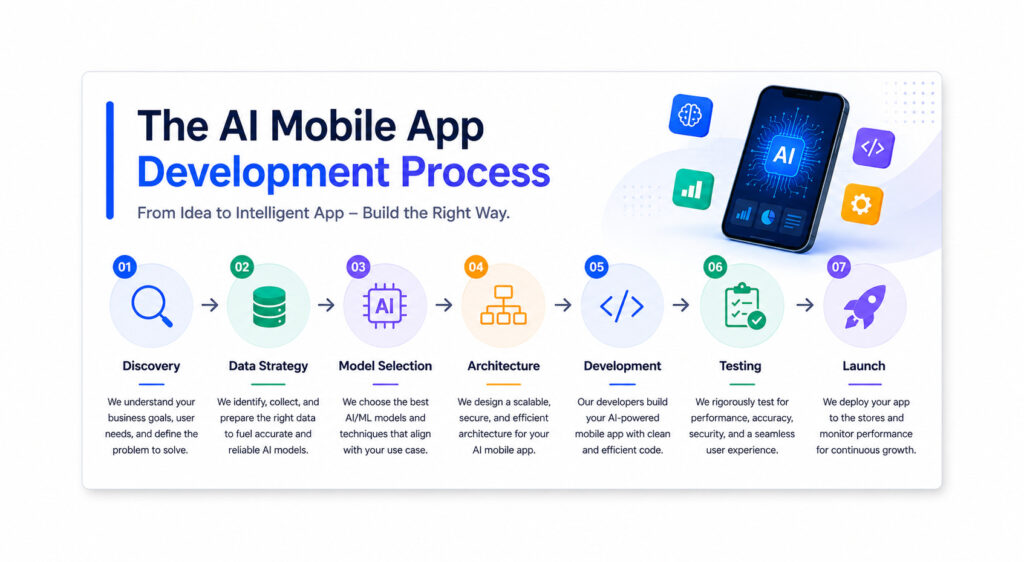
The AI Mobile App Development Process Used by AI Mobile App Development Companies
Discovery and scoping — defining which AI capability actually solves the business problem, rather than adding AI for its own sake.
Data strategy — identifying what data the AI feature needs, how it’s sourced, cleaned, and kept compliant.
Model selection or training — choosing between pre-trained models, fine-tuning, or building custom models depending on the use case.
Mobile architecture — deciding what runs on-device (for speed and privacy) versus in the cloud (for heavier computation).
Development and integration — building the app and wiring the AI feature into the actual user experience.
Testing and monitoring — validating model accuracy and app performance, then setting up ongoing monitoring since AI features drift over time.
Launch and iteration — releasing, gathering usage data, and refining the model or feature based on real behavior.
What Affects AI Mobile App Development Cost at AI Mobile App Development Companies
However, costs vary widely across AI mobile app development companies depending on a few consistent factors:
-
- Model complexity — using an existing AI API costs far less than training a custom model from scratch.
-
- Data volume and quality work — cleaning and preparing training data can be a significant share of the budget.
-
- On-device vs cloud processing — on-device AI often adds development time but reduces ongoing cloud costs.
-
- Platform scope — building for iOS and Android natively costs more than a single cross-platform build.
-
- Compliance requirements — healthcare, finance, and other regulated industries add development and audit overhead.
-
- Ongoing model maintenance — AI features typically need retraining and monitoring after launch, which should be budgeted as a recurring cost, not a one-time expense.
A simple app with one AI feature built on an existing API can be considerably cheaper than a product built around a custom-trained model with heavy compliance needs — get a detailed scoping conversation before comparing quotes across companies, since the same “AI mobile app” label can mean very different amounts of work.
Frequently Asked Questions (FAQs)
“`


.webp)