
August 27, 2026
Category: E-Commerce
For details on Shopify’s app ecosystem and platform capabilities, see the official Shopify developer documentation where an off-the-shelf plugin just doesn’t fit how their store actually works. That’s when merchants start looking into Shopify app development services — whether that means a fully custom build, a private app for internal operations, or a public app meant for the App Store itself. In this guide, we break down what Shopify App Development Services actually involves, what it costs, how the process typically unfolds, and the benefits worth weighing before you commit budget to a build
Why Merchants Move Beyond Off-the-Shelf Apps
Pre-built apps work well for common requirements. However, your store may eventually need something more specific. As a result, working with a Shopify app development company that can build exactly what you need—rather than stitching together three apps that only partially solve the problem—can save both money and headaches over the long term.
Types of Shopify Apps You Can Build
- Public apps — listed on the Shopify App Store, available to any merchant, and reviewed against Shopify’s technical and design requirements.
- Custom (private) apps — built for a single store, used for internal tools, unique storefront features, or integrations that don’t need to be shared publicly.
- Embedded apps — run inside the Shopify admin using Shopify’s App Bridge, giving merchants a native-feeling experience without leaving the dashboard.
- Shopify plugin development for storefront-facing features like custom product configurators, subscription logic, or checkout extensions built with Shopify’s Checkout Extensibility framework.
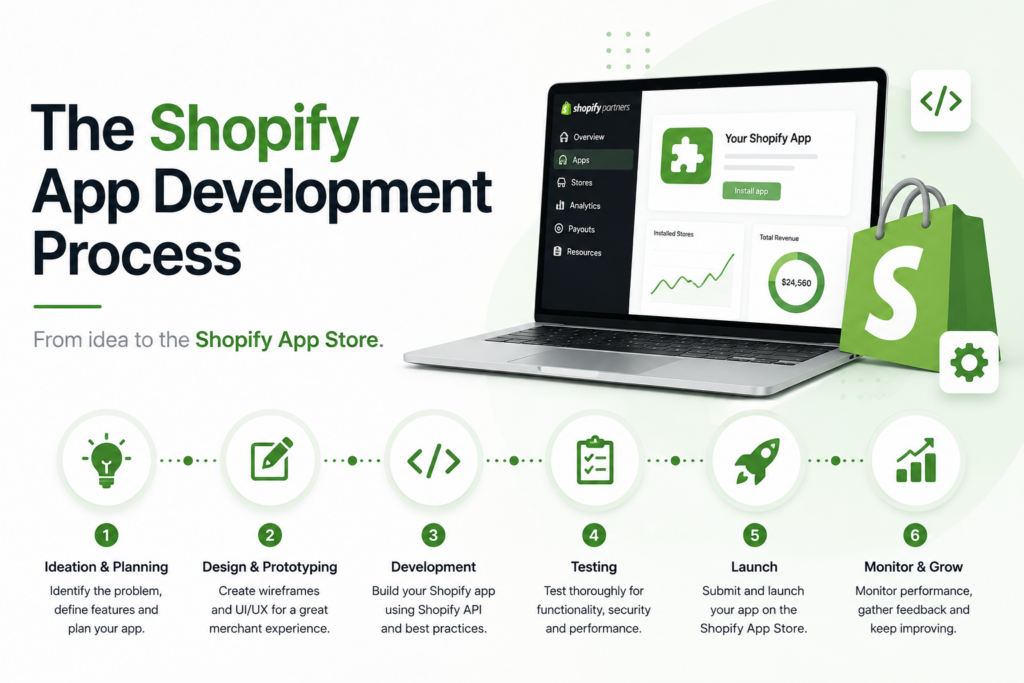
The Shopify App Development Process
Generally, a well-run Shopify app development process moves through these stages:
- Discovery and scoping — mapping the exact workflow or gap the app needs to solve, and deciding whether it should be public, private, or embedded.
- Architecture and API planning — deciding which Shopify APIs (Admin API, Storefront API, Webhooks) the app depends on, and how it authenticates.
- Design — for embedded apps, this usually follows Shopify’s Polaris design system so the app feels native inside the admin.
- Development — building the app logic, database, and any external integrations it needs to talk to.
- Shopify app integration — connecting the app to the merchant’s existing stack: inventory systems, CRMs, shipping providers, or accounting software.
- Testing and Shopify review — for public apps, this includes Shopify’s own approval process before the app can be listed.
- Launch and iteration — post-launch monitoring, bug fixes, and feature additions based on real usage.
Shopify App Development Cost
Shopify app development cost varies widely based on scope. However, rough ranges can help with planning.
- Simple private app (single integration or internal workflow tool): often a few weeks of work, with budgets typically in the low four figures to low five figures.
- Mid-complexity custom app (multiple integrations, custom admin UI, subscription or loyalty logic): usually 6-10 weeks, with costs scaling into the mid five figures depending on integration count.
- Full public App Store app: often takes 3+ months. Costs are higher because of additional design, documentation, billing, and Shopify review requirements.
Several factors affect Shopify app development costs. These include the number of third-party integrations and supported store configurations. Custom admin UI can also increase the overall cost.
Benefits of Shopify App Development Services
- Exact fit for your workflow instead of adapting your business to a generic app’s limitations.
- Fewer app subscriptions — one purpose-built app can replace three or four partial-fit plugins.
- Better performance since custom apps aren’t carrying features you don’t use.
- Ownership of the code, meaning no dependency on a third-party vendor’s roadmap or pricing changes.
- Scalability — a custom app can grow with your catalog size, order volume, and store complexity in ways generic apps often can’t.
Choosing the Right Shopify App Development Company
When evaluating a partner, ask about their experience with Shopify’s Admin and Storefront APThe Shopify App Development ProcessIs. Ask whether they’ve shipped apps through Shopify’s public review process. Also, check how they handle Shopify app integration with ERPs and marketing platforms. A team that only builds themes may have limited app-development experience. Custom apps require knowledge of app architecture, API authentication, and webhook handling.


.webp)