
September 8, 2026
Category: Shopify Development
Shopify app development services help businesses build custom applications that improve store functionality, automate repetitive tasks, and support business growth. A suitable Shopify app can help merchants create new revenue opportunities, streamline operations, manage inventory, and deliver better customer experiences. Because ready-made Shopify apps do not always meet specific business requirements, many brands invest in custom Shopify app development services.
If you are researching Shopify app development services, you likely want to understand the Shopify app development cost, essential features, development process, and how to choose the right development partner. This guide covers these factors to help you make informed decisions before starting development or signing an agreement.What Are Shopify App Development Services?
Shopify app development is the act of building software that adds functions to a Shopify store. For example, these applications can link to external databases such as resource planners or customer managers, automate inventory and order tasks, or provide tools for shopper loyalty and subscriptions. Because ready-made tools may not solve every business problem, many businesses use Shopify app development services to address specific operational or marketing needs.
Moreover, modern digital commerce involves more than displaying products and receiving payments. For this reason, businesses facing high competition or complex logistics often require smarter workflows. A functional Shopify application connects the storefront to back-office software and marketing tools. As a result, it can reduce manual work, prevent mistakes, increase transaction value, and provide data that supports specific business goals.
Categories of Shopify Applications
The main categories of applications determine the plan for creation and Shopify app development cost. Public applications are available on the Shopify App Store for many merchants who need tools for emails, reviews or sales – those require a structure that handles many users, strong data security plus clear instructions for new users.
But custom Shopify app development is for one merchant or a small group of stores. They are not on the public list and address specific needs like shipping rules or unique pricing – those applications are a secure way to add functions without sharing the software with other businesses.
The Shopify admin area contains embedded applications – those use specific design systems to appear as part of the Shopify interface. They are useful when a merchant manages data directly from the dashboard. To provide services outside of Shopify, external applications use programming interfaces to handle commerce data.
Characteristics of Successful Shopify Applications
The features of an application depend on the problem it solves. First, strong security and clear data permissions are necessary. An application should only request the data it needs and clearly explain how that data is used. In addition, simple setup steps and helpful instructions can reduce support requirements and encourage users to remain active.
Furthermore, performance is a significant factor. Applications that slow down page loading or the payment process can negatively affect the user experience. For example, reliable APIs and background tasks can help keep an application responsive during high-traffic periods. Meanwhile, error tracking and monitoring help developers identify problems and maintain data consistency across different systems.
Finally, the merchant interface is important. Using standard Shopify design components helps merchants recognize filters, lists, and other controls. As a business grows, features such as multi-store support, specific user permissions, and data exports may also become important.
To choose features, consult with a professional.
Shopify App Development Services: Development Process
Professional Shopify app development projects follow a specific lifecycle – the process starts with a discovery phase where stakeholders define business goals and expected results, like a percentage increase in revenue. The team identifies data paths but also user roles.
The next phase is the design of the architecture – the team decides if the application is public or custom and which programming interfaces to use. They create diagrams as well as maps for the data. For a loyalty tool, they design how users earn points and how the store displays rewards.
The actual programming begins after the design is ready – back-end developers create the core services or link the databases to Shopify. Front end developers build the interfaces for merchants and shoppers. Quality testing happens at the same time to check the code in private stores. Public applications must also pass a security next to experience review by Shopify.
The final phases are deployment and support – applications live on servers that can handle growth. The team fixes bugs plus updates the software for new versions of Shopify. Many projects improve over time based on feedback from staff and data.
Shopify App Development Services: Technology & Architecture
Developers use various technologies for Shopify application development – many teams use Node.js or Ruby on Rails because Shopify provides many tools for the languages. Python or PHP are also options for linking to existing systems. The choice depends on the skills of the developers but also the complexity of the project.
For data developers use systems like PostgreSQL or MySQL – they use caching tools to process data quickly during inventory updates or order syncs. React is a common tool for building the merchant interface. If a merchant needs a very fast storefront, developers use specific frameworks for performance.
The architecture must handle many users and keep data separate. A public application requires a design that keeps the information of different merchants secure. Custom Shopify app development services use strategies to handle data limits as well as secure storage of digital keys. Observability tools allow the team to see problems during busy sales periods.
Shopify App Development Services: Factors Affecting Cost
The Shopify app development cost depends on multiple variables. Primarily, the amount of work and overall complexity influence the final price. An application that only moves data into a file is less expensive than a tool that uses calculations to optimize inventory across multiple channels. Similarly, integrations with shipping or marketing software can increase development and testing requirements.
In addition, specific feature requirements can change the total cost. For example, dashboards for different user roles or unique storefront components require additional development and testing. Furthermore, if an application must follow strict data rules, it may require specialized infrastructure or security audits.
The location and experience of the partner affect the cost. A large company in North America often has a higher hourly rate than a small team in a different region. Experience next to speed are factors that can lower the overall risk of the project. Fixed-price projects usually involve a clearly described set of tasks with regulated modifications. In contrast time-and-materials agreements provide higher adaptability but require you to manage the project with strict oversight to prevent the addition of unplanned features.
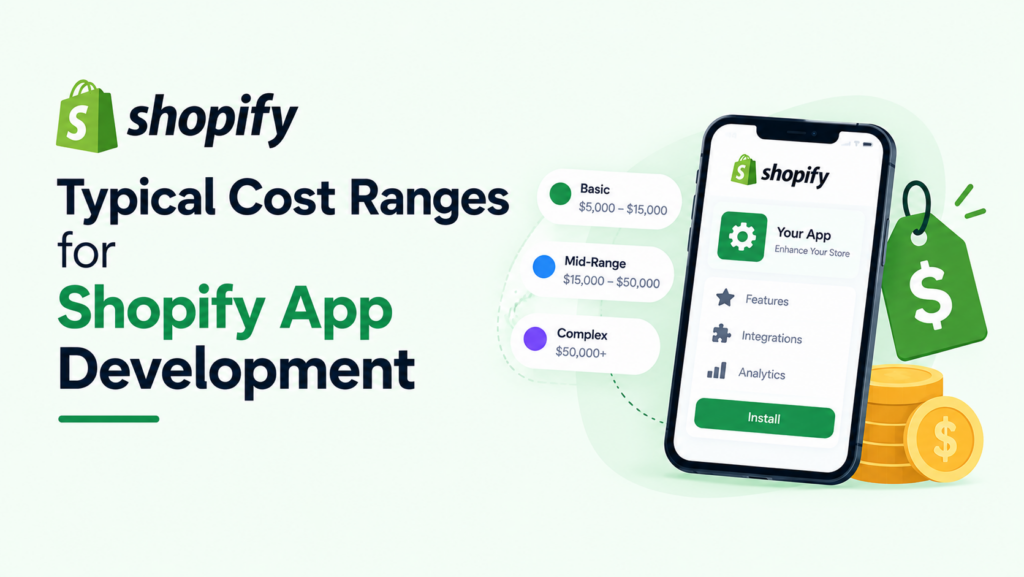
Typical Cost Ranges for Shopify App Development
Shopify app development costs can vary depending on the app’s features, integrations, complexity, and customization requirements. Typical development ranges include:
- Basic Shopify App: $5,000–$15,000 — simple features and limited integrations.
- Mid-Range Shopify App: $15,000–$50,000 — advanced features, custom workflows, and multiple integrations.
- Complex Shopify App: $50,000+ — enterprise-level functionality, complex integrations, automation, and scalability.
Comparison – Custom Shopify Apps vs Off-the-Shelf Shopify Apps
To determine if you require a custom Shopify app development, you can compare it to existing software in the Shopify App Store. The table below lists the differences between building a custom app and using a ready made product.
| Aspect | Custom Shopify App Development | Off-the-Shelf Shopify Apps |
|---|---|---|
| Fit to business processes | Matches your specific work steps exactly | Matches some steps – may require you to change your methods |
| Upfront Shopify app development cost | Requires more money at the start | Costs little or nothing at the start – requires a monthly fee |
| Long term total cost | Can cost less over time if used frequently | Requires monthly payments that increase as you add more apps |
| Time to market | Requires more time based on the number of features | Available for use immediately |
| Competitive advantage | Includes unique tools that other merchants cannot use | Includes tools that any merchant can buy |
| Control over roadmap | You decide which features to add | The developer decides which features to add |
| Integration depth | Connects deeply with your internal databases | Connects only to the systems the developer chooses |
| Maintenance responsibility | Your employees or your contractors fix problems | The software seller fixes problems |
The owners of many retail brands begin with ready made tools and pay for custom Shopify app development later to replace missing features or combine multiple tools into one efficient program.
Business Benefits of Investing in Shopify App Development Services
The use of Shopify app development services can change how employees perform their daily tasks. First, automation is a primary benefit. A custom app that connects orders to warehouse software can remove manual data entry and reduce mistakes. As a result, automated customer labelling and order routing can also make the shipping process faster.
In addition, custom apps can help increase the amount a customer spends over time. For example, product-bundling logic can change according to current stock, while algorithms can suggest relevant products to buyers. Instead of changing business processes to fit a generic tool, companies can build software around their specific customer behaviour.
From a data perspective, an app can bring information together that was previously stored across different spreadsheets. Consequently, businesses can create reports for indicators such as subscription cancellations or profit by product group. This information, in turn, can help teams make decisions and test new ideas more quickly.
There is also a benefit regarding your long term strategy – if you own your software, you are less vulnerable to price increases or the sudden closure of a software company. You can plan your future features based on your own goals. By working with a Shopify app development company, you gain access to methods that have worked for other retailers.
How to Choose Shopify App Development Services
Choosing the right partner for Shopify app development services is a significant decision. You should examine their history of working specifically with Shopify. It is not enough for them to know how to change the visual theme. You must ask for examples of apps they have built, especially those that perform complex tasks.
Evaluate Shopify App Development Technical Expertise
The technical skill of the team is another important factor. A capable team should understand the Shopify Admin, Storefront and Graph APIs, as well as webhooks, OAuth and Polaris. They should also show that they can build systems that are secure and can handle many users. Ask how they manage data limits, integrations and system failures. Their answers will help you determine whether they can build reliable software.
Check Communication, Pricing & Ongoing Support
The way developers communicate and manage the project will affect your experience. Establish how often they will provide updates and what tools they will use to communicate with you. The development team should be transparent about the Shopify app development cost, including the price of future updates and maintenance. A good partner can also help you launch a basic version first and add features based on user feedback.Conclusion – Turning Your Shopify App Vision Into Reality
Shopify app development services are central to retail operations because they control inventory, pricing and customer experiences. If you understand the types of apps and the development process, you can plan your budget and avoid mistakes. The cost of a Shopify app depends on the number of features and the skill of the developers.
The goal is to build technology that helps you reach your business targets. A combination of a good plan and technical skill can turn an app into a valuable asset. If you are ready to start, you should define your goals and choose a partner who knows your industry.
Explore more insights at Autviz Solutions.


.webp)