
August 26, 2026
Category: E-Commerce
Every e-commerce brand eventually asks the same question: do we need a website, an app, or both? The honest answer is that it depends on where your customers are and how they buy — but for most growing brands, the winning move is a Shopify-powered store paired with a native or cross-platform app built by an experienced e-commerce mobile app development company. Working with a Shopify Store Development Services team from day one means the storefront and the app are built on the same backend from the start, instead of being bolted together later. This guide explains how ecommerce app development can help brands decide when an app earns its place next to their website. It also covers Shopify’s benefits, essential features, development costs, timelines, and post-launch growth strategies.
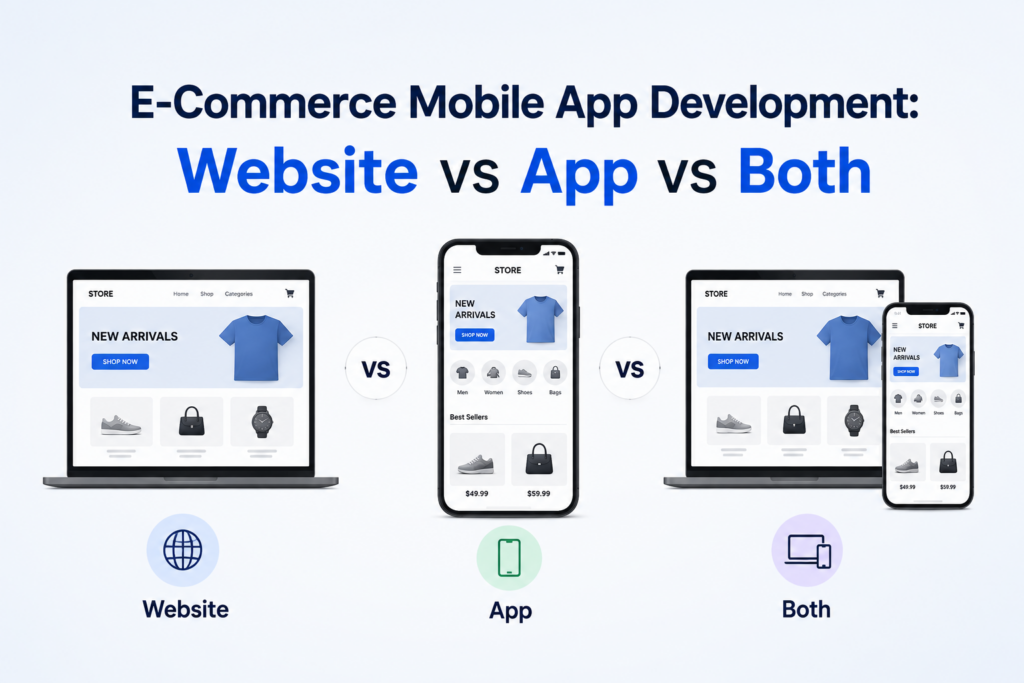
E-Commerce Mobile App Development: Website vs App vs Both
A responsive Shopify website covers the basics: discovery through search and social, one-off purchases, and a low-friction entry point for new customers. It’s usually the right starting point for any brand.
For brands with repeat buyers, ecommerce app development can create a stronger retention channel alongside the website. Apps unlock push notifications, saved payment details, and faster checkout. They also support loyalty features that a mobile browser cannot match. A store with high repeat-purchase rates, a subscription model, or a loyal community typically sees the strongest return from investing in an app alongside the website.
For brands scaling past their first few thousand orders, running both isn’t overkill — it’s how the biggest direct-to-consumer names capture both new and returning customers without losing either audience to friction. his is the kind of roadmap decision an experienced Shopify app development team should help you make before committing budget to either build before committing budget to either build.
Why Shopify Is Best for E-Commerce Mobile App Development
Shopify provides a strong foundation for ecommerce app development, including product, order, payment, and customer management.You can learn more about the platform on the official Shopify website.
- Speed to market. Core commerce features are already built and tested. These include product catalogs, carts, checkout, payments, and shipping. Development can therefore focus on differentiation.
- A mature app ecosystem. Shopify has a mature app ecosystem covering reviews, subscriptions, loyalty, upsells, and marketing. This can reduce custom development and long-term maintenance.
- Reliable checkout and payments. Shopify provides a PCI-compliant checkout environment. This reduces the complexity of handling payments in a custom e-commerce build.
- Headless flexibility. Shopify’s APIs make it straightforward to power a fully custom storefront or a native mobile app on top of the same backend, so brands aren’t locked into a generic theme experience.
For a brand comparing a fully custom build against Shopify, the math almost always favors Shopify unless the business has genuinely unique commerce logic that off-the-shelf platforms can’t support. This is exactly why Shopify ecommerce app development has become the default path for brands that want a fast launch without giving up room to customize later.his is where an e-commerce mobile app development company can help brands choose the right Shopify architecture and mobile app strategy.
E-Commerce Mobile App Development: Must-Have Features
A Shopify store built through ecommerce app development needs more than basic functionality to convert.
The features that consistently move conversion rate include:
- One-tap checkout. Saved cards, address autofill, and Shop Pay or equivalent express checkout options cut abandonment dramatically.
- Real product search and filtering. Shoppers may leave quickly when they cannot find what they need. Fast, typo-tolerant search and useful filters can keep them browsing.
- Social proof at the point of decision. Place reviews, ratings, and user photos near the “Add to Cart” button. Avoid hiding social proof on a separate tab.
- Mobile-first product pages. Since most e-commerce traffic is mobile, product pages need to load fast, display clearly on small screens, and keep the buy button visible without scrolling.
- Abandoned cart recovery. Automated email, SMS, and push flows recover a meaningful share of otherwise lost sales.
- Personalization. Recommended products based on browsing and purchase history increase average order value without extra ad spend.
None of these are exotic — they’re table stakes for a store built by a serious e commerce app development company, but they’re frequently the first things skipped under launch deadlines. Brands with unusual catalog or loyalty requirements may need custom ecommerce mobile app development. This allows Shopify features to support specific business needs.
E-Commerce Mobile App Development Cost and Timeline
Ecommerce app development timelines and budgets vary by scope, but a typical Shopify build at Autviz follows a predictable path:
- Weeks 1–2: Discovery and planning. Defining catalog structure, must-have integrations (payments, shipping, ERP), and whether a companion app is in scope.
- Weeks 3–4: Design. Custom UI design for the storefront, built around conversion-focused product and checkout pages rather than a stock theme.
- Weeks 5–8: Development. Theme customization or headless storefront build, app integrations, and — if included — the native or cross-platform mobile app running on the same Shopify backend.
- Weeks 9–10: QA and launch prep. Testing checkout flows, payment gateways, and device compatibility, followed by store migration and go-live.
A standard Shopify storefront typically launches in six to eight weeks; adding a companion mobile app usually extends the timeline by another four to six weeks, depending on the app’s feature set. As an e-commerce mobile app development company, Autviz builds the app on the same Shopify backend as the storefront. This eliminates the need to maintain a separate data layer. Budget scales similarly — a focused storefront is a fraction of the cost of a storefront-plus-app build, and both scale further with the depth of custom integrations required.
Post-Launch: The Growth Features That Pay for Themselves
Launch is the starting line, not the finish. Ecommerce app development can continue after launch with features that improve retention and revenue:
- Loyalty and rewards programs that turn one-time buyers into repeat customers.
- Subscription options for consumable or replenishable products, which stabilize revenue month over month.
- Push notifications can support back-in-stock alerts, price drops, and abandoned cart reminders. They can become a high-ROI channel once an app has an active user base.
- A/B tested product and checkout pages to squeeze incremental conversion gains out of existing traffic rather than paying for more of it.
- Advanced analytics and cohort tracking to understand which customer segments and channels actually drive repeat revenue.
Brands that treat these as a second phase — rather than trying to launch with everything on day one — tend to ship faster and iterate based on real customer behavior instead of guesswork.
If your brand sells physical products, fulfilment and delivery are also important. Our upcoming guide on On-Demand & Logistics Apps covers this topic in more detail. And if you want the full picture of what a Shopify build involves end to end, our Shopify Store Development Company page and our E-commerce & Retail industry page cover the specifics in more depth.


.webp)