
August 27, 2026
Category: E-Commerce
Clinics and hospitals are under constant pressure to modernize patient experience. They must also protect sensitive health data. You may be evaluating a healthcare app development company for a new patient portal. You may also be exploring telemedicine app development or an internal workflow tool. Healthcare projects have higher stakes than typical consumer apps.. A single compliance gap can mean fines, breach notifications, and lost patient trust. In this guide, we’ll cover what HIPAA-ready development requires. We’ll also explain how to choose the right type of app, which features matter most, and what realistic budgets and timelines look like.
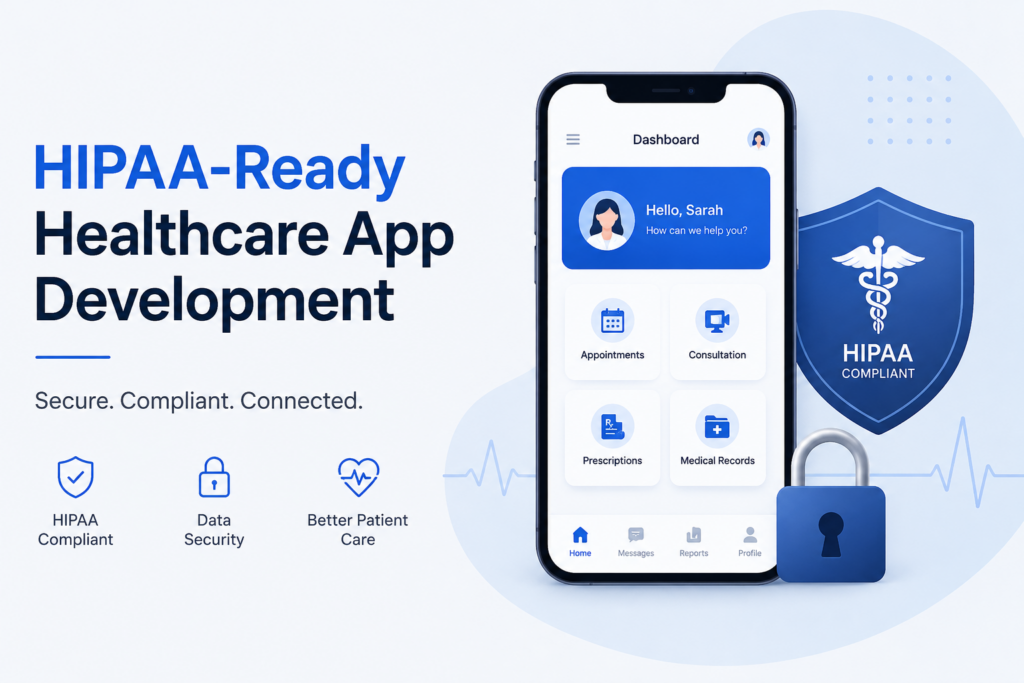
What a Healthcare App Development Company Must Provide
“For official HIPAA requirements, healthcare organizations can refer to the U.S. Department of Health & Human Services HIPAA guidance At minimum, a compliant build needs:
- Data encryption in transit and at rest for all Protected Health Information (PHI), using industry-standard protocols.
- Access controls and audit logs so every view, edit, or export of patient data is tied to an authenticated user and timestamped.
- Business Associate Agreements (BAAs) with every third-party vendor that touches PHI — cloud hosting, SMS/email providers, analytics tools, and payment processors included.
- Role-based permissions so front-desk staff, clinicians, billing teams, and administrators only see what their role requires.
- Secure authentication, typically multi-factor, for both patient-facing and staff-facing accounts.
- Data retention and breach-response policies that are documented, tested, and reviewed on a schedule — not written once and forgotten.
An experienced healthcare app development company builds these requirements into the architecture. This is better than retrofitting them after a security review.
Patient Portals vs Telemedicine vs Internal Operations Apps
Not every healthcare organization needs the same kind of app. These three categories solve different problems, and mixing them up early is one of the most common — and costly — planning mistakes.
Patient Portals
Patient portals give patients self-service access to appointment scheduling, lab results, prescription refills, billing, and secure messaging with their care team. As a result, they can reduce front-desk workload and improve patient satisfaction.. They reduce front-desk call volume and improve patient satisfaction scores, but they require tight integration with your EHR/EMR system to stay useful rather than becoming “yet another login” patients ignore.
Telemedicine Apps
Telemedicine app development is its own discipline. However, a real telemedicine product requires more than video calling. It needs low-latency, HIPAA-compliant video infrastructure, virtual waiting rooms, e-prescribing, digital consent capture, and insurance workflows. Clinics offering remote consultations often need specialized telemedicine app development services. The team should understand licensing rules across states or regions. Compliance requirements can vary based on the patient’s location during the visit.
Internal Operations Apps
These are staff-facing tools: shift scheduling, inventory and equipment tracking, internal case notes, referral management, or dashboards that give administrators a real-time view of patient flow. They don’t always touch PHI as heavily as patient-facing apps. However, when they do, the same compliance rigor applies.
Must-Have Features from a Healthcare App Development Company
Regardless of which category you’re building, several features can determine whether an app gets adopted or abandoned:
- EHR/EMR integration — data should flow both ways, not require duplicate manual entry.
- Appointment scheduling and reminders with automated SMS/email notifications to reduce no-shows.
- Secure messaging between patients and providers, logged and encrypted.
- Digital intake forms and e-consent to cut down on paper and front-desk bottlenecks.
- Billing and insurance verification workflows built into the patient journey.
- Accessibility compliance (WCAG standards) so the app works for patients with disabilities.
- Offline resilience or graceful degradation for clinics with inconsistent connectivity.
- Analytics dashboards for administrators to track utilization, appointment volume, and patient satisfaction.
Why Choose a Healthcare App Development Company?
Autviz has worked with clinics and hospital groups to design and build patient-facing and internal healthcare software with HIPAA compliance treated as a core requirement rather than an afterthought. That experience spans patient portal builds tied into existing EHR systems, telemedicine platforms supporting real-time video consultations, and internal operations tools that help administrative teams manage scheduling and patient flow more efficiently. If you’re comparing a Healthcare App Development Services provider, it’s worth asking directly about their track record with BAAs, prior audits, and how they structure access controls — the answers tell you a lot about how seriously compliance is taken beyond the sales conversation.
Healthcare App Development Company Cost and Timeline
Every healthcare app project is different. However, rough benchmarks can help with planning::
- Simple patient portal (scheduling, messaging, basic EHR sync): typically 3–5 months, with budgets often starting in the low-to-mid five figures and scaling based on integration complexity.
- Telemedicine platform (video consults, e-prescribing, billing): generally 5–8 months, with costs rising due to video infrastructure, compliance work, and multi-role workflows.
- Internal operations tools (scheduling, inventory, dashboards): often the fastest to ship, in the 2–4 month range, especially when they don’t require deep EHR integration.
- Full-scale hospital systems spanning multiple app types and legacy system integrations can run well beyond a year and require phased rollouts.
These ranges depend on several factors. These include third-party integrations and the number of user roles. Your project scope also changes based on whether you serve one clinic or multiple locations. Any healthcare app development company worth hiring should be willing to walk through a detailed estimate rather than quoting a number before understanding your existing systems.


.webp)